BREAKING

Thursday, February 1, 2024

VP Sara vows to sustain momentum in pursuing MATATAG reforms in BER 2024


Wazzup Pilipinas!?


Vice President of the Philippines and Secretary of Education Sara Z. Duterte on Thursday conveyed the commitment of the Department of Education (DepEd) in achieving the MATATAG Agenda during her second Basic Education Report.

In her report, VP Sara highlighted major accomplishments a year after the launch of the agency’s MATATAG Agenda, including the pilot implementation of the MATATAG Curriculum, the rollout of the National Learning Camp and Catch-Up Fridays, the expansion of School-Based Feeding Program, and the strengthening of learner protection mechanisms, among others.

“As we stand here today, we reaffirm our commitment to this colossal endeavor – unfazed by the unthinkable. We will bravely take on this challenge of sustaining our actions in our MATATAG Agenda,” VP-Sec. Duterte said.


Most notably, Duterte declared that DepEd will release the policy on the removal of administrative tasks of teachers on Friday, 26 January.

“Let’s bring our teachers back to the classrooms,” she emphasized.

Furthermore, VP Sara said that the Department will also issue an Employee Welfare and Well-being Policy guidelines soon, while establishing a Calamity Fund for teachers and personnel is in the pipeline.

In terms of improving learning outcomes, she shared that DepEd will conduct the phased implementation of the MATATAG Curriculum next school year. A National Math Program and National Science & Technology Program will also be implemented by the agency.

In addition, the Education Secretary highlighted the agency’s aim to fully digitize all DepEd offices and schools nationwide through the DepEd Digi-Ed 2028. Further, she also assured that DepEd will provide school-wide Wi-Fi, electronic textbooks and digitized large-scale evaluation and assessment tools on the development of the learners.

DepEd will likewise aim to launch the MATATAG Portal, a one-stop-shop platform for teachers, learners, and partners to access learning materials and education information.

“Mga kababayan, hindi po tayo hihinto sa kabila ng iba’t ibang anyo ng pagsubok, dahil mas mahalaga po na makita natin ang maraming mukha ng tagumpay at mga natupad na pangarap ng ating kabataan dahil sa ating pagtutulungan, dahil sa ating pagiging MATATAG,” VP-Sec. Duterte noted.



VP Sara, DepEd affirm poverty reduction efforts through accessible, quality education transition of the 14 schools


Wazzup Pilipinas!?


Spearheaded by Vice President of the Philippines and Secretary of Education Sara Z. Duterte, the Department of Education (DepEd) affirmed its commitment to poverty reduction efforts of President Ferdinand Marcos Jr.’s administration during the Bagong Pilipinas Kick-off Rally on Sunday.


VP-Secretary Duterte led the DepEd delegation in the festive inter-agency gathering at the Quirino Grandstand, showcasing its support for the Bagong Pilipinas, a multi-layered campaign of the country’s bid to push progress.


During the Basic Education Report 2024, VP-Sec. Sara Duterte noted that education is a pillar of poverty reduction and emphasized that the Department’s programs and initiatives under the MATATAG Agenda are aligned with the Bagong Pilipinas of the PBBM administration.


“We must raise our children to carry this resilience within their hearts and minds for their future,” she said.


In improving the quality of education, DepEd is set to roll out the phased implementation of the MATATAG K-10 Curriculum next school year.


Further, DepEd has also partnered with various organizations to provide entrepreneurship and employment opportunities for learners and communities.


Finally, DepEd will be expanding the School-Based Feeding Program to cover the entire school year starting School Year 2024-2025.


Paint by Numbers: UP Mathematician Formulates Rules in Modeling Crystal Structures


Wazzup Pilipinas!?


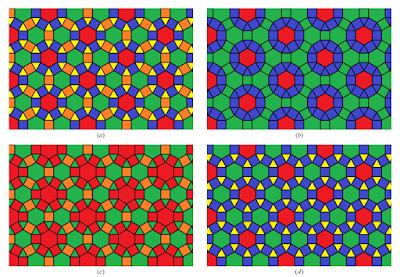
Different ways of coloring a pattern. (Photo credit: Junio, A. O. Colorings of patterns fixed by an arbitrary finite-index subgroup of the Symmetry Group. Acta Crystallographica Section A Foundations and Advances, 79(6): p.558.)


Imagine yourself standing on a concrete floor. Your goal is to completely cover the floor with red and blue square tiles, but in a way that follows three rules:


1) Every time you step on a tileless area, you must lay a tile. You can place either a red or blue tile on your starting position.

2) When you move one step horizontally or vertically, you must place a tile that is not the same color as the one you left. For example, if you started on a red tile and moved right, left, up, or down, lay a blue tile on your new location.

3) When you move one step diagonally, you must place a tile with a similar color to the tile you left. If you were standing on a red tile and moved diagonally, lay a red tile.


Once you have covered the floor with tiles, you will have created a colored checkerboard pattern. More interestingly, you will have also created a 2D model for the structure of salt crystals, which consists of alternating sodium and chlorine atoms: Red tiles can represent sodium atoms, while blue tiles can represent chlorine atoms.


Coloring a pattern such as the checkerboard is simple, but it becomes more complicated as patterns become more intricate. Dr. Allan Junio of the UP Diliman College of Science Institute of Mathematics (UPD-CS IM) created a technique that systematically colors patterns, helping model the structures of crystals.


Much like the three-step process in tiling the floor, Dr. Junio’s technique involves a set of general mathematical rules, called theorems and lemmas, in coloring different patterns. Moreover, his method enumerates all possible ways a pattern can be colored while limiting the number of colors used.


“The reason for this restriction is that we will be applying the coloring framework on the atoms of crystal structures, where the colors correspond to exactly one kind of atom, and we will be dealing with crystal structures with only finitely many kinds of atoms,” Dr. Junio explained in his paper.


The technique can help model a process called ordered substitution, where a group of atoms are replaced with a different element, thereby deriving a new material.


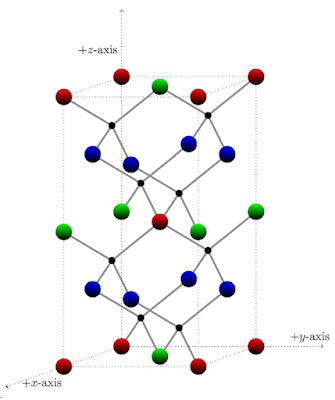
To demonstrate, he applied his technique to sphalerite crystal – a mineral that is difficult to identify due to its similarity with other crystals, hence its name coming from the Greek word sphaleros, meaning “treacherous.” Sphalerite is commonly made up of zinc and sulfur atoms linked together in a pattern.


Model for the structure of sphalerite. Zinc atoms are colored green, red, and blue, while sulfur atoms are colored black. (Photo credit: Junio, A. O. Colorings of patterns fixed by an arbitrary finite-index subgroup of the Symmetry Group. Acta Crystallographica Section A Foundations and Advances, 79(6): p.555.)


Instead of representing all zinc atoms with only one color, he colored different groups with green, red, and blue. In doing so, ordered substitution becomes simpler: by replacing the blue zinc atoms with copper atoms, the green zinc atoms with iron atoms, and the red zinc atoms with tin atoms, a new material called stannite is produced. Other crystals such as kuramite and chalcopyrite can also be produced using a similar process.


Although only sphalerite and its derivatives are modeled in the paper, the technique can be applied to other crystals as well.


“It may be a good idea to determine whether the resulting colorings correspond to known compounds, and if no such compounds exist, to establish whether the colorings may be realized as physical structures using chemical and molecular properties and restrictions,” Dr. Junio concluded in his paper, which is now published in Acta Crystallographica.


By Harvey Sapigao

Ang Pambansang Blog ng Pilipinas Wazzup Pilipinas and the Umalohokans. Ang Pambansang Blog ng Pilipinas celebrating 10th year of online presence
 
Copyright © 2013 Wazzup Pilipinas News and Events
Design by FBTemplates | BTT
